
Ebbinghaus Forgetting Curve: Exact Percentages, Evidence, and How to Beat It
See the exact Ebbinghaus forgetting curve percentages, the original 1885 source, modern spaced repetition evidence, and what to do to remember more.

AI Researcher & Software Engineer
Who Was Hermann Ebbinghaus?
Hermann Ebbinghaus (1850-1909) was a German psychologist who pioneered the experimental study of memory. Before his work, memory was considered too subjective to measure scientifically. Ebbinghaus proved otherwise by using himself as the test subject in a series of rigorous experiments that lasted over two years.
To eliminate the influence of prior knowledge, Ebbinghaus invented "nonsense syllables" (consonant-vowel-consonant combinations like DAX, BUP, ZOL) that carried no meaning. He memorized lists of these syllables, then tested himself at precise time intervals to measure exactly how much he retained. The result was the forgetting curve: the first quantitative model of human memory decay.
Ebbinghaus Forgetting Curve Exact Percentages
The two views below show the same data: how much is forgotten and how much is still retained.
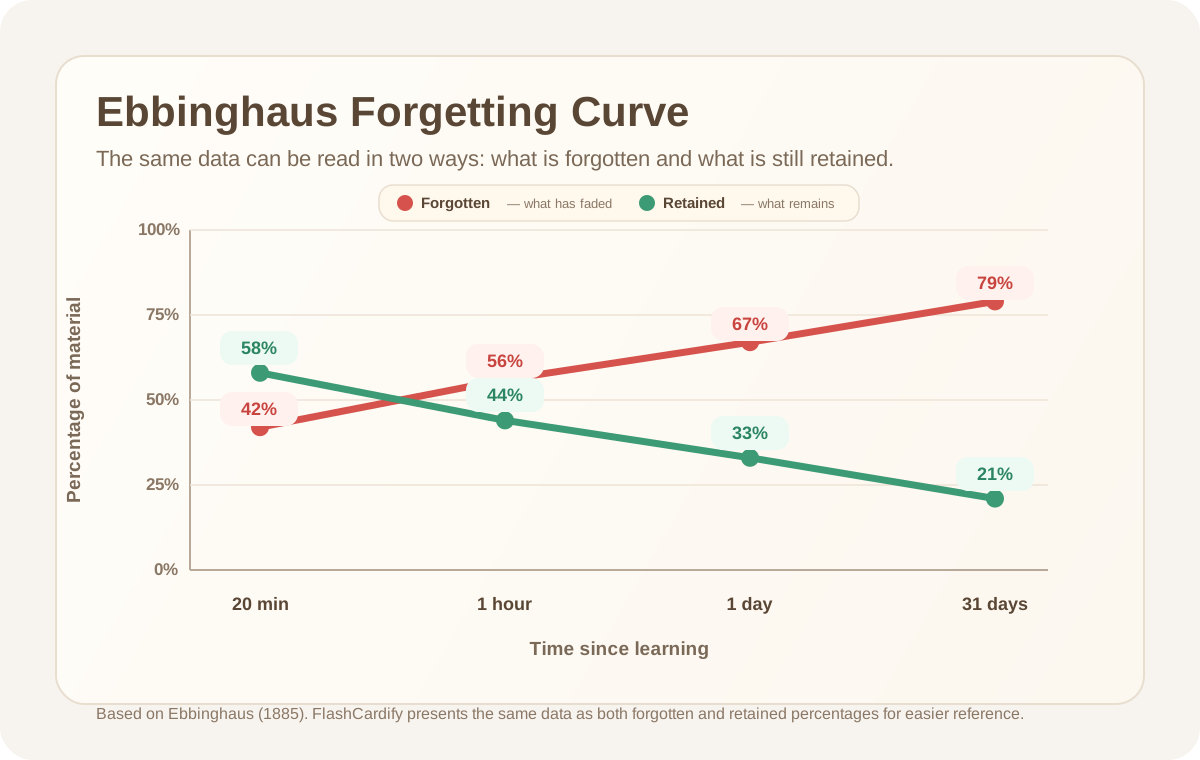
The same forgetting-curve data can be framed as material forgotten or material retained. Both views describe the same memory-decay pattern.
Some sources describe these values as percentage forgotten, while others emphasize the remaining percentage retained. Both framings refer to the same underlying curve.
Based on Ebbinghaus (1885) and the original forgetting-curve data.
The Forgetting Curve: Original Data
Ebbinghaus published his findings in "Memory: A Contribution to Experimental Psychology" (1885). The data showed that memory retention drops sharply in the first minutes after learning, then levels off into a more gradual decline. Here are the exact numbers from his research:
Ebbinghaus Forgetting Curve Data
Source: Ebbinghaus, H. (1885). Memory: A Contribution to Experimental Psychology. Values represent the percentage of "savings" lost at each interval.
The most striking takeaway: almost half of what you learn is gone within 20 minutes. After a single day, only about a third remains. And after a month, you retain barely one-fifth of the original material. This rapid, exponential decay is why cramming the night before an exam produces such poor long-term results.
The Mathematical Model Behind the Curve
Ebbinghaus described the forgetting curve with the formula:
R = e(-t/S)
R = retention (percentage of material remembered)
t = time since learning
S = relative strength of memory (stability)
e = Euler's number (approximately 2.718)
The key variable is S, the stability of the memory. When S is low (new, weakly-encoded information), the curve drops steeply. When S is high (well-rehearsed material), the curve flattens. This is the fundamental insight behind spaced repetition: each review session increases S, making the memory more resistant to decay.
Modern Evidence: Has the Forgetting Curve Held Up?
Over 140 years of research have largely confirmed Ebbinghaus's findings. Modern studies using brain imaging, large-scale datasets, and diverse populations show remarkably consistent results. Here is what contemporary science tells us:
Key Research Findings
Murre & Dros (2015) - Replication Study
Replicated Ebbinghaus's original experiment with modern methodology. Results closely matched the 1885 data, confirming the forgetting curve's shape and timing. Published in PLOS ONE, this study validated that the core pattern holds across different experimental conditions.
Cepeda et al. (2006) - Meta-Analysis of 184 Studies
Analyzed 184 articles involving 317 experiments on spacing effects. Found that distributed practice (spaced repetition) consistently outperformed massed practice (cramming) by 10-30% across all study types and age groups.
Karpicke & Roediger (2008) - Testing Effect
Demonstrated that active retrieval (testing yourself) combined with spacing produced 150% better long-term retention compared to restudying. Published in Science, this is one of the strongest pieces of evidence for spaced repetition.
Mettler et al. (2016) - Adaptive Spacing
Showed that adaptive spacing algorithms (like those used in modern flashcard apps) outperform fixed spacing schedules by adjusting review intervals based on individual performance.
Evidence by the Numbers
What Affects the Rate of Forgetting?
Ebbinghaus's original curve represents a baseline for meaningless material. In practice, several factors influence how quickly or slowly you forget:
Meaningfulness of the Material
Meaningful, connected information is retained much longer than isolated facts. Ebbinghaus himself noted that meaningful text was forgotten about 10 times more slowly than nonsense syllables. This is why flashcards with context and explanations work better than those with isolated terms.
Emotional Significance
Emotionally charged information activates the amygdala, which strengthens memory encoding. Material that surprises, interests, or personally matters to you resists forgetting more effectively.
Prior Knowledge
New information that connects to existing knowledge is easier to retain. When you already have a mental framework for a subject, new facts "stick" more readily because they attach to established neural networks.
Sleep and Rest
Sleep plays a critical role in memory consolidation. Studies show that sleeping after learning significantly reduces the forgetting rate. The brain replays and strengthens new memories during slow-wave sleep.
Active Retrieval vs. Passive Review
Simply re-reading material does little to combat forgetting. Actively testing yourself (the testing effect) is far more powerful. This is exactly what flashcard-based study does: it forces active recall rather than passive recognition.
How Spaced Repetition Defeats the Forgetting Curve
Spaced repetition is the single most effective strategy for flattening the forgetting curve. The principle is simple: review material at gradually increasing intervals, timed to occur just before you are about to forget. Each successful recall strengthens the memory and pushes the next review further into the future.
How Spaced Repetition Changes the Curve
With each review at the right moment, the forgetting curve resets but starts from a higher point and decays more slowly:
- • After 1st review: Retention resets to ~100%, next review needed in ~1 day
- • After 2nd review: Retention resets, next review needed in ~3 days
- • After 3rd review: Retention resets, next review needed in ~1 week
- • After 4th review: Retention resets, next review needed in ~2 weeks
- • After 5th review: Retention resets, next review needed in ~1 month
Eventually, well-reviewed material can be retained for months or years with only occasional refreshers. The key is timing each review before the forgetting curve drops too low.
Practical Tips: Applying the Science to Your Studying
- 1Do not cram. Massed practice (studying everything in one session) creates the illusion of learning because material feels familiar in the short term. But the forgetting curve shows that without spacing, most of it will be gone within days.
- 2Review within 24 hours. The steepest part of the forgetting curve is in the first hour. A quick first review within a day can recover most of what was lost and dramatically slow future decay.
- 3Test yourself, do not just re-read. Active recall (flashcards, practice questions) is vastly more effective than passive review. Each retrieval attempt strengthens the memory trace.
- 4Let an algorithm handle the scheduling. Manually tracking optimal review intervals for hundreds of flashcards is impractical. Spaced repetition software automates this by scheduling each card at the ideal time based on your past performance.
- 5Make it meaningful. Connect new facts to things you already know. Use examples, analogies, and personal relevance. Meaningful material follows a much gentler forgetting curve than isolated facts.
Beat the Forgetting Curve with FlashCardify
FlashCardify puts the science of the forgetting curve to work for you. Its adaptive spaced repetition algorithm schedules each flashcard review at the optimal moment, personalized to your performance. Cards you struggle with appear more frequently; cards you have mastered move to longer intervals. The result: maximum retention with minimum study time.
You can also generate flashcards with AI from your PDFs, YouTube videos, or text, and organize them into structured learning curricula for a complete study system built on evidence.
References and source trail
These are the main works behind the percentages, replication discussion, and modern spacing evidence summarized on this page.
Replication and analysis
Modern supporting evidence
- Cepeda, N. J., Pashler, H., Vul, E., Wixted, J. T., & Rohrer, D. (2006). Distributed practice in verbal recall tasks: A review and quantitative synthesis. Psychological Bulletin, 132(3), 354-380.
- Karpicke, J. D., & Roediger, H. L. (2008). The critical importance of retrieval for learning. Science, 319(5865), 966-968.
- Mettler, E., Massey, C. M., & Kellman, P. J. (2016). A comparison of adaptive and fixed schedules of practice. Journal of Experimental Psychology: General, 145(7), 897-917.
Embed or download the chart
If you want to cite this page in a blog post, lecture note, or study guide, you can download the SVG or embed the chart directly.
HTML embed
Markdown embed
If you reuse the visual, link back to this page so readers can verify the original percentages and source context.
Cite this page
If you are referencing this explanation rather than the original paper directly, use the citation format below and add your access date.
Suggested citation
For formal academic work, cite the original Ebbinghaus paper and any modern replication or spacing studies directly whenever possible.
Want to estimate your own next review window?
Use the forgetting curve calculator to estimate retention, forgetting, and the next useful review point based on time since last review, review count, and difficulty.
Open the forgetting curve calculatorFrequently Asked Questions
What is the Ebbinghaus forgetting curve?
The Ebbinghaus forgetting curve is a mathematical model of memory decay discovered by German psychologist Hermann Ebbinghaus in 1885. It shows that without reinforcement, we forget approximately 42% of learned material within 20 minutes, 56% within an hour, and up to 79% within 31 days. The curve follows an exponential decay pattern described by the formula R = e^(-t/S), where R is retention, t is time, and S is memory stability.
How much do we forget after 20 minutes?
According to Ebbinghaus's original research, we forget approximately 42% of newly learned material after just 20 minutes. This is the steepest part of the forgetting curve. After 1 hour the figure rises to 56%, after 1 day to 67%, and after 31 days to 79%.
Has the Ebbinghaus forgetting curve been scientifically verified?
Yes. Over 140 years of research have confirmed Ebbinghaus's findings. A landmark 2015 replication study by Murre and Dros (published in PLOS ONE) closely matched the original 1885 data. A meta-analysis by Cepeda et al. (2006) analyzed 184 articles and 317 experiments, consistently finding that spaced repetition outperforms massed practice by 10-30%.
How can I beat the forgetting curve?
The most effective strategy is spaced repetition: reviewing material at gradually increasing intervals timed just before you are about to forget. Each successful recall strengthens the memory and pushes the next review further into the future. Research by Karpicke and Roediger (2008, published in Science) showed that active retrieval combined with spacing produced 150% better long-term retention compared to passive restudying.
What factors affect how quickly I forget?
Five main factors influence forgetting speed: (1) meaningfulness of the material (meaningful text is forgotten 10x more slowly than nonsense), (2) emotional significance, (3) prior knowledge and existing mental frameworks, (4) sleep quality (sleep consolidates memories during slow-wave sleep), and (5) whether you use active recall vs. passive re-reading.
Related Articles
The Science Behind Spaced Repetition: Why It Works
Explore the psychological and neurological foundations of spaced repetition and understand why it's the most effective learning technique.
The Complete Guide to AI Flashcard Generation
Learn how artificial intelligence revolutionizes flashcard creation and discover the best practices for generating effective study materials automatically.